What is the point of speech and language technology? What is it actually useful for? The honest answer is a wide range of things, and which matters most depends on the most pressing problems a language community is facing.
There is also a gap between technology and its applications. To a lot of people, a speech recognition model is fairly abstract: hard to see, hard to use, easy to forget about. An application that solves a real problem is not. So alongside building speech recognition for Manx, I wanted to put it to work somewhere useful. The result is a searchable corpus of spoken Manx.
Decades of recordings you couldn’t search
Over decades, the Manx community has created a wealth of naturally occurring speech: radio broadcasts, conversations recorded and shared on YouTube, readings of texts, and language-learning material. Text can be searched; audio, until now, could only be listened to from start to finish. If you wanted to hear how a particular word or phrase is used by real speakers, there was no practical way to find it.
What it does
You type a word or phrase, and the search returns every place it is spoken, with a transcript showing it in its surrounding context. Each result has a timestamped link that takes you to the precise point in the original recording where it is said. In effect, it is an index of spoken Manx.
The corpus covers 11,903 recordings, 353 hours in total.
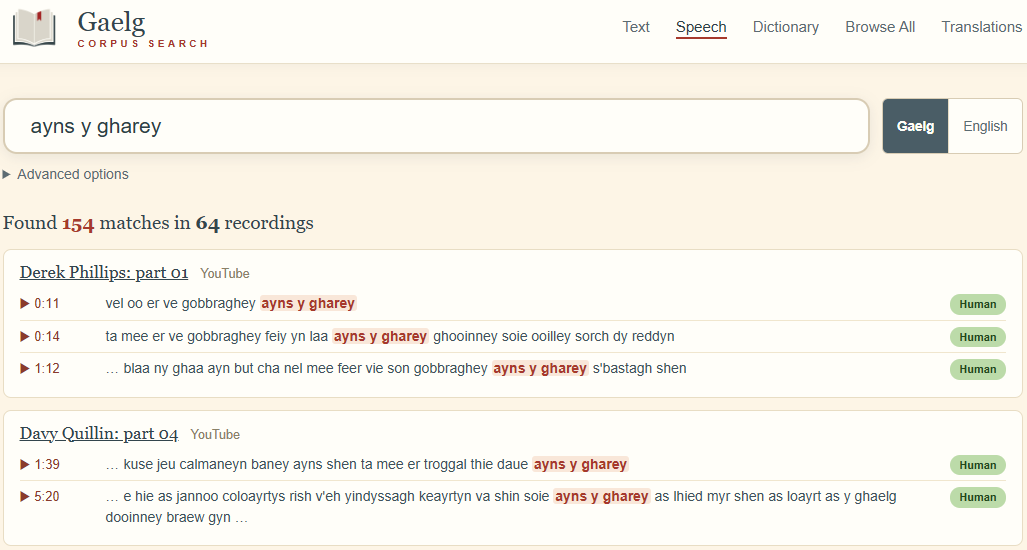
How it was built
- Human transcripts were included as they are.
- Untranscribed recordings were transcribed by several speech recognition systems fine-tuned for Manx. Where the systems agree, that agreement acts as a measure of confidence.
- Everything was then force-aligned with Kaldi, using the same alignment approach as my research, so that every word has a timestamp.
- Low-confidence segments and recordings, where the systems disagree with each other, are flagged as such, so you know when to treat a transcript with care.
Who it’s for
Learners who want to hear a word or phrase used in real speech, by many different speakers. Educators looking for authentic examples. Researchers studying the language. And anyone with an interest in Manx. I shared it with Ynsee Gaelg, a Facebook group for Manx learners, and the feedback has been good.
Thank you
The search is free and open to everyone. But none of it would exist without the people who created these recordings: the broadcasters, speakers, readers and teachers who, over decades, have put a huge amount of work into recording Manx and sharing it. This tool only makes their work easier to find. Every result links back to the original recording.