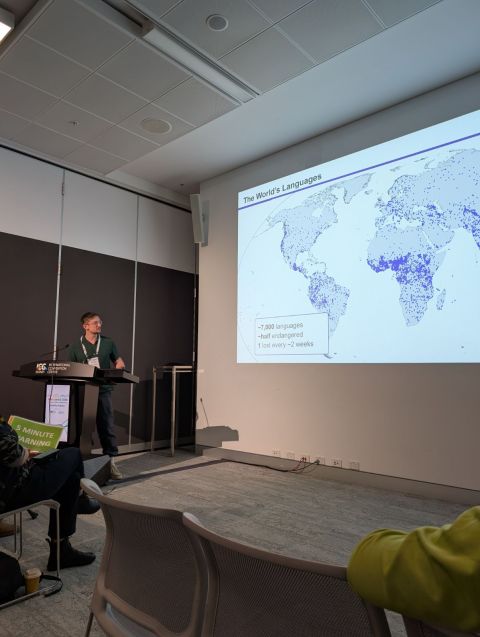
At the end of September I presented my paper, Bootstrapping Endangered Language ASR with Short-Form Corpora, at Interspeech 2026 in Sydney.
The talk
My talk was in an oral session on the Tuesday of the conference. The paper asks whether the resources many endangered-language communities already have, such as spoken dictionaries and long recordings with loosely matching transcripts, can be used to build speech recognition without a conventional training corpus. It tests the idea on five languages: Cornish, Hawaiian, Jejueo, Manx and Mohawk. You can read the paper in the ISCA Archive, or find a summary on my research page.
The conference
Tuesday was the most interesting day for me, with a lot of sessions close to my own area. Across the week there were plenty of interesting keynotes, posters and oral sessions to choose from.
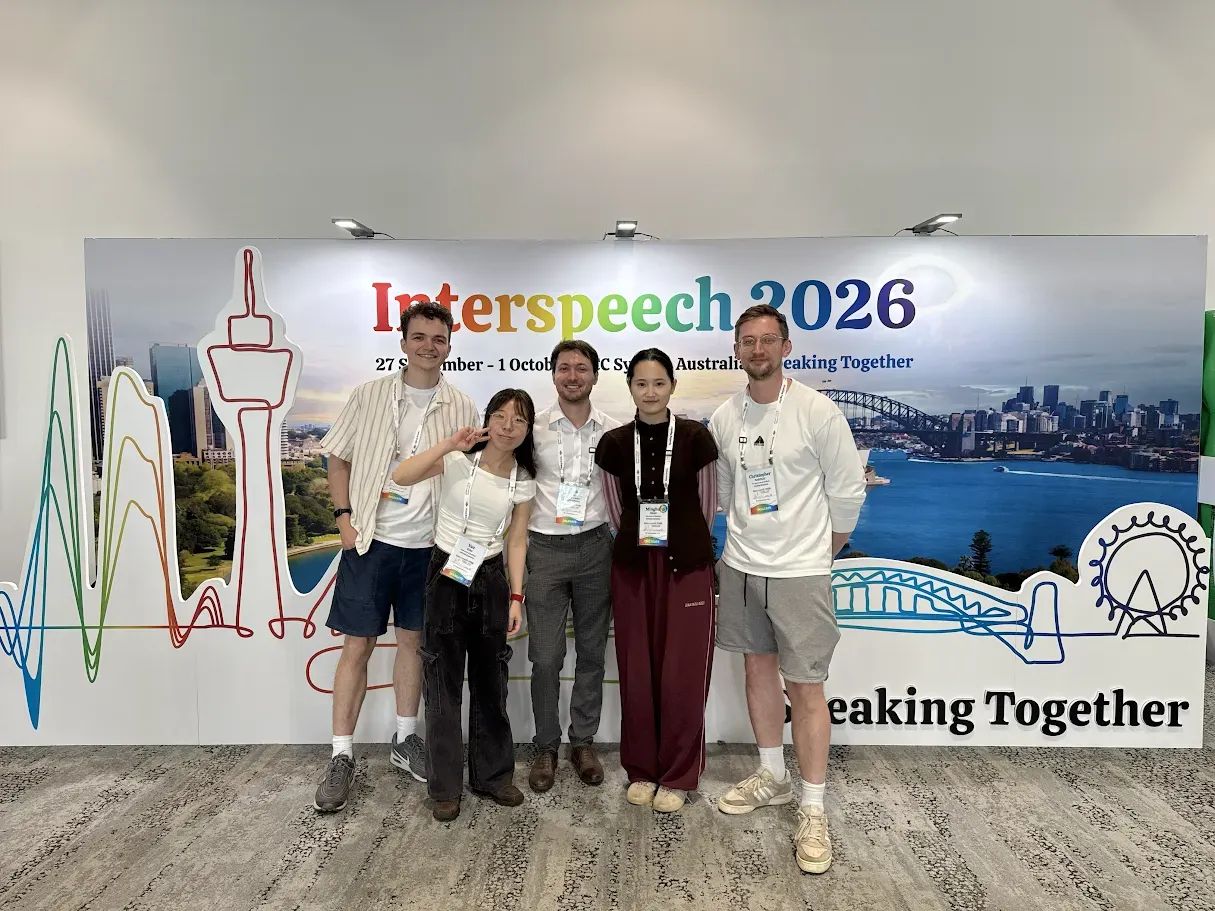
The best part was the people. I met researchers whose papers I had read and was finally able to put faces to names. I was also there alongside other PhD students from Sheffield.
What I took away
I came away with a newfound love for the process: doing the work, writing it up, and capping it off by presenting it at a conference like Interspeech. I can see how doing that repeatedly gives you a sense of community.
Sydney
I arrived a week early to do some travelling. Sydney is an amazing place, and I was gutted not to have time to see more of Australia. I’ll be back for sure.